نوع مقاله : مقاله پژوهشی
عنوان مقاله English
نویسندگان English
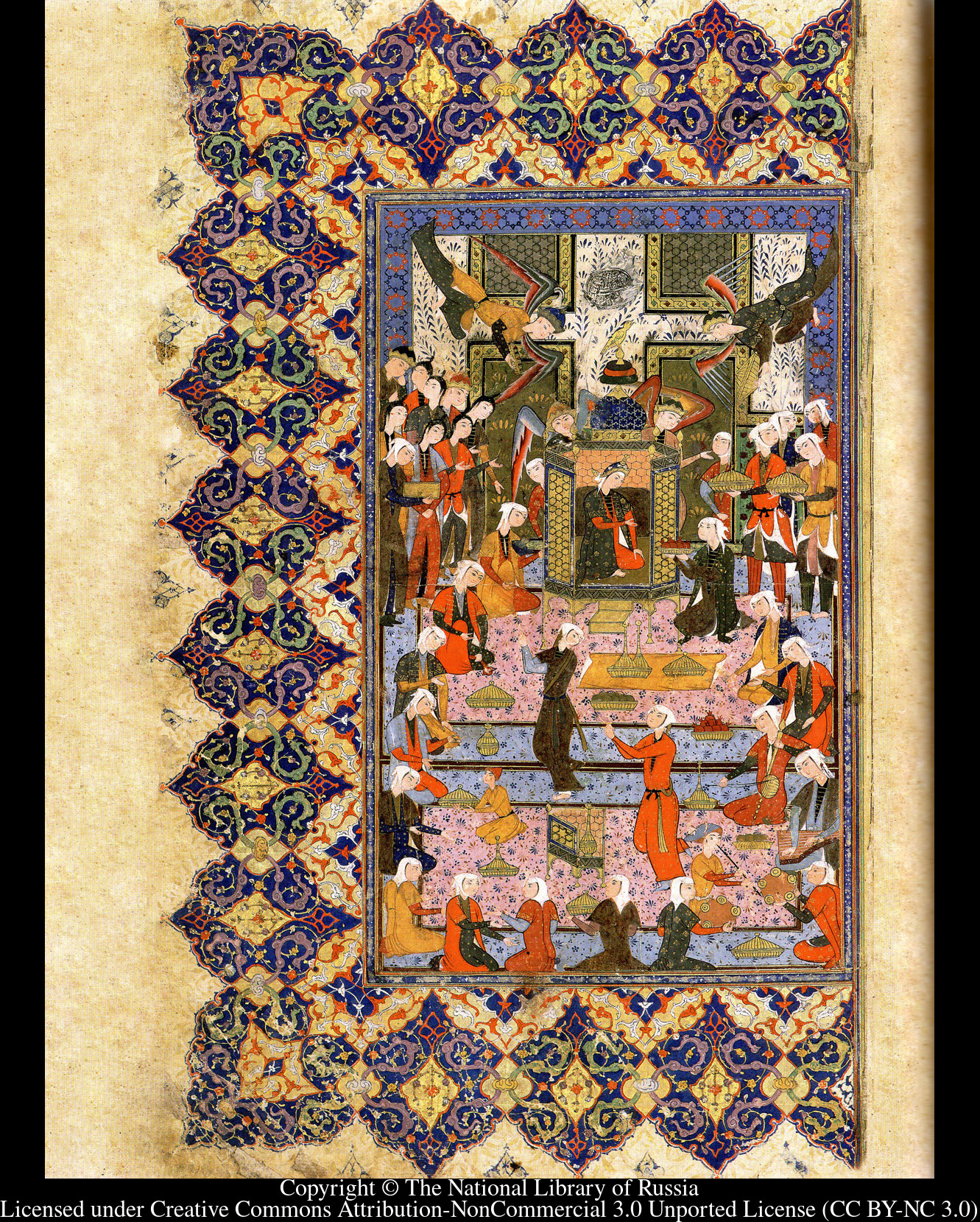
Introduction: The Safavid period marks a peak in Iranian visual arts, especially miniature painting, supported by political stability and royal patronage that produced numerous illustrated Shāhnāmeh manuscripts. Frontispiece illustrations, often double-page compositions with refined illumination, vibrant colors, and extensive gold, served beyond decoration as statements of royal authority and legitimacy. They frequently depicted battle, festivity, or mythological scenes affirming dynastic grandeur. The Qur’anic narrative of Solomon (Sulaymān) and Bilqīs became a favored frontispiece subject from the mid-ninth/fifteenth century. As a prophet-king commanding humans, jinn, animals, and winds, Solomon embodied the ideal of combined spiritual and temporal power. The Safavid Shiraz school, rooted in Inju and Timurid traditions, reached refinement in the sixteenth and early seventeenth centuries. While absorbing influences from Tabriz, Mashhad, and Qazvin, it retained distinctive traits: naturalism, meticulous detail, vibrant costume, crowded compositions, ultramarine-gold palette, and a modular grid-based structure integrated with text. Many dispersed Shiraz manuscripts remain understudied. This article examines two anonymous frontispiece pairs of Solomon and Bilqīs: one from a Shāhnāmeh dated 940–950 AH / 1533–1543 CE in the David Collection, Copenhagen, and another from a Shāhnāmeh dated 990–1000 AH / 1582–1592 CE in the Freer Gallery of Art. These previously unexamined works illuminate the visual language, symbolism, and inter-school dynamics of Safavid Shiraz painting.
Purposes & Questions: The principal aim is to identify shared features and distinctive differences in visual elements, symbolism, and school influences in the two frontispiece pairs. The study examines how Shiraz artists imaginatively reinterpreted the Solomon–Bilqīs narrative through visual and symbolic means, how compositional and iconographic choices evolved over the fifty-year interval, and how earlier traditions— Ilkhanid, Timurid, and early Safavid styles of Tabriz and Qazvin—shaped their formal and symbolic vocabulary. Three research questions guide the inquiry: (1) How is the artist’s imaginative interpretation of the Solomon and Bilqīs narrative manifested through visual and symbolic motifs in each pair? (2) What commonalities and unique differences appear in visual compositions, figural types, architectural settings, and treatment of supernatural beings? (3) In what ways have earlier painting traditions influenced the stylistic, structural, and symbolic qualities of these Shiraz works? Addressing these questions advances understanding of the Safavid Shiraz school’s identity within Persian manuscript painting and highlights frontispiece imagery as a vehicle for the intertwined ideals of kingship, prophecy, and divine favor.
Methods: The research employs a descriptive-analytical methodology grounded in iconography and supported by library investigation. Iconographic analysis decodes layered meanings of motifs—thrones, angels, demons (dīv), animals, birds, architecture, and landscape—while comparative analysis identifies formal, compositional, and symbolic correspondences and divergences. Each pair is examined independently for composition, geometry (hidden frameworks, golden-section divisions, index-square placement of principal figures), figural typology, color symbolism, and fidelity to the Qur’anic account in Sūrat al-Naml. The pairs are then compared, and their relation to selected earlier and contemporary manuscripts (Shāhnāmeh of Shah Tahmasp, Khamsa of Shah Tahmasp, Shāhnāmeh of Shah Ismail II, and Shāhnāmeh of Qavam) is assessed to trace influence. Sampling was purposeful: the two double-page frontispieces were selected from a corpus of approximately twenty-five Solomon–Bilqīs illustrations for their shared Safavid Shiraz attribution, use of gold and silver, and status as opening pages of Shāhnāmeh manuscripts.
Findings and Results: Comparative analysis reveals clear contrasts illuminating continuity and change within the Safavid Shiraz school. The David Collection frontispieces (ca. 1533–1543 CE) project Solomon’s regal power through a resplendent throne with arabesques and dragon heads, dense demons, rich animals and birds (hoopoe, simurgh, predator and prey at a silver pool), elaborate architecture with star-and-cross tiled floors, and a golden sky. These features echo Ilkhanid and Timurid conventions of lavish royal imagery. Bilqīs appears veiled and contemplative, emphasizing wisdom; demons around her suggest temptation. Silver marks water and gold marks celestial elements. By contrast, the Freer Gallery frontispieces (ca. 1582–1592 CE) adopt a restrained composition privileging Solomon’s spiritual authority and the ideal of the just ruler uniting religion and governance. The outdoor setting features spongy rocks, blue sky with swirling clouds, and paired Safavid carpets. Angels display naturalistic Iranian faces, some wearing börk headgear; one dances amid musicians, introducing Samā. Demons are fewer and distant; animals are largely omitted from Bilqīs’s page. Bilqīs reclines unveiled and relaxed, aligning with Shiraz naturalism. Solomon’s calm posture, Iranian features, and subdued palette underscore a spiritual ideal of kingship. Both pairs use Shiraz network composition, placing principal figures in index squares above the midline. Shared motifs—thrones, angels with golden flames or fruit, animal-headed demons, the simurgh, and gold-ultramarine symbolism—demonstrate iconographic continuity. Differences reflect chronological development: the earlier works retain stronger Mongol–Timurid traits and denser supernatural populations; the later works show greater naturalism, open space, and integration of Safavid courtly fashion. Inter-school analysis confirms that David Collection illustrations draw on dragon and rocky-landscape conventions of Aqa Mirak and Tabriz artists, while Freer illustrations affiliate more closely with later Shiraz and Qazvin works, including the Shāhnāmeh of Qavam.
کلیدواژهها English